



Indian clubs are far more than traditional shoulder tools. When used correctly, Indian clubs train timing, rhythm, spatial awareness, & control — qualities governed primarily by the nervous system rather than the muscles alone. For anyone seeking better coordination, improved movement quality, & long‑term joint health, Indian club training offers a unique form of circular strength training that traditional weight training rarely provides.
This guide explains how Indian clubs train the nervous system, why they improve coordination, & how incorporating Indian clubs into training can enhance functional strength, shoulder mobility, & overall movement efficiency.
What Makes Indian Clubs Different from Traditional Weight Training
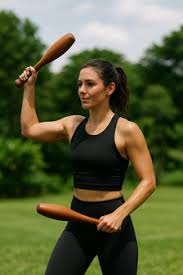
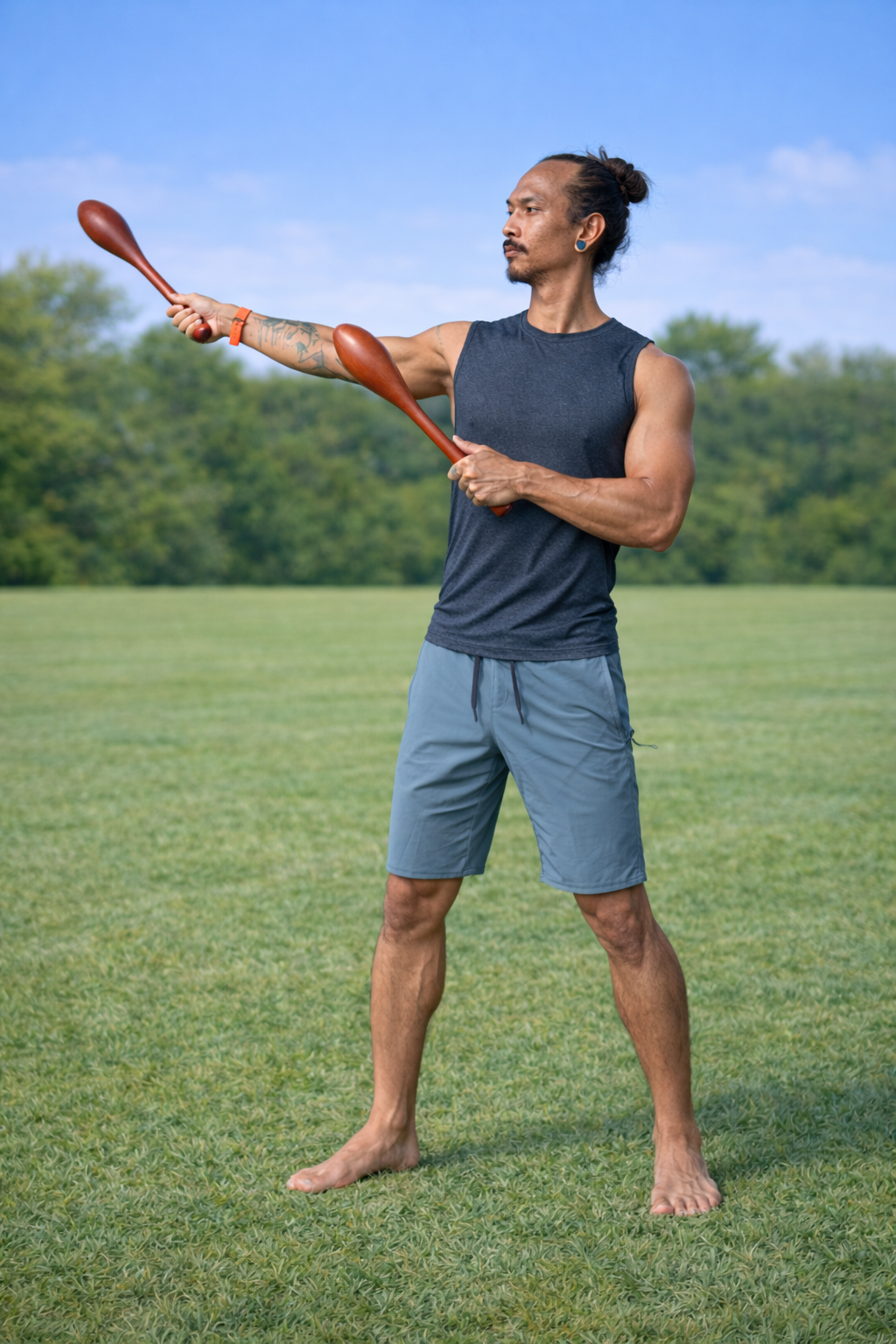
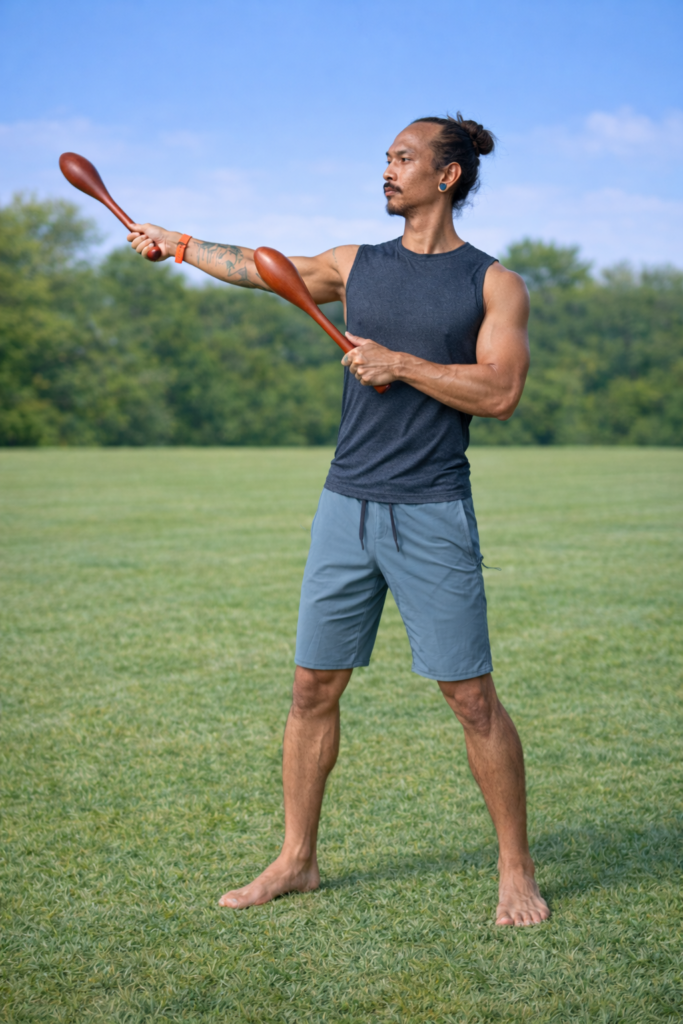
Unlike linear exercises performed with dumbbells or machines, the clubs use offset weighted clubs that move through the circular patterns. These swinging motions require continuous adjustment from the nervous system, forcing the body to maintain balance, timing, & posture during motion.
Where traditional training focuses on isolated upper body strength, clubs engage multiple muscle groups simultaneously. They combine grip strength, core stability, rotational strength, & joint stability into one coordinated movement system.
Because clubs exercises require control rather than brute force, they develop strength while protecting joints.
How Indian Clubs Train the Nervous System (NS)
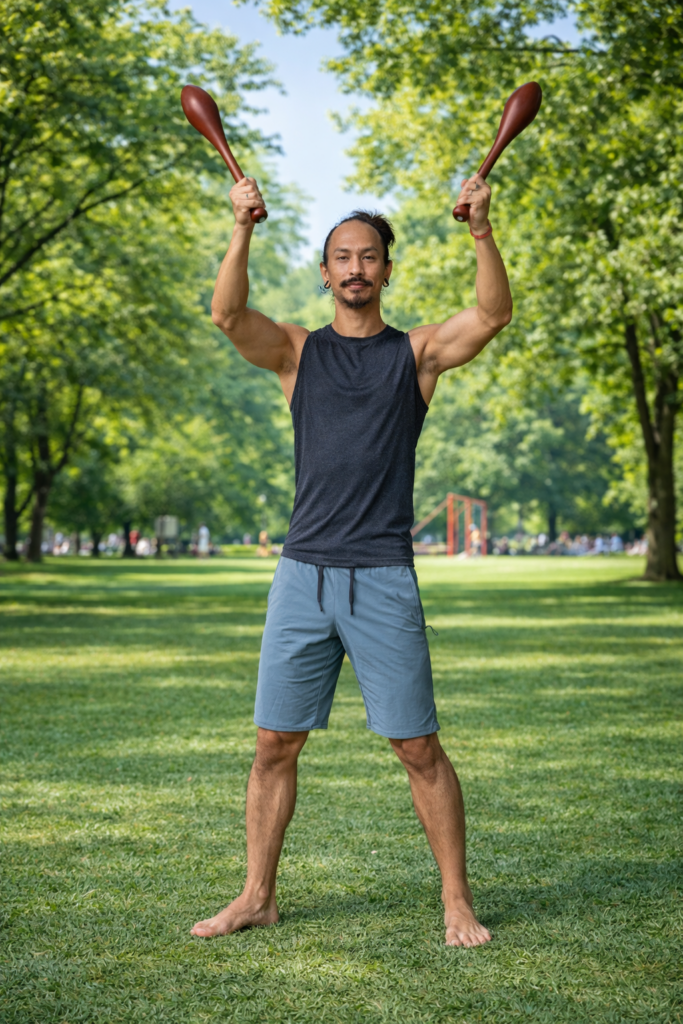
The key reason the clubs improve coordination is that club training is fundamentally neurological. Every swing requires the brain to predict motion, regulate force, & organise posture in real time.
Indian club training improves the NS by:
- teaching the brain to coordinate both arms simultaneously
- improving timing between the shoulders, core, & hips
- enhancing spatial awareness during circular movements
- reinforcing posture control during flowing movements
- strengthening the mind body connection
How Indian Clubs Improve Coordination & Motor Control
This ancient practice exercises develop coordination by forcing the body to manage rhythm, direction, & momentum simultaneously. This challenges the brain’s ability to sequence movement smoothly.
With consistent practice, Indian clubs help:
- improve bilateral coordination
- increase body awareness
- refine movement patterns
- enhance mental focus
- improve balance during motion
These benefits make Indian clubs especially valuable for fitness enthusiasts, combat athletes, martial artists, & anyone seeking better physical conditioning without excessive load.
The Role of Circular Swinging Patterns in Brain Training
Circular swinging patterns are the defining feature of incorporating Indian club exercises. These patterns require constant micro‑adjustments in grip, shoulder position, & core engagement.
This results in:
- improved shoulder mobility & functional range
- stronger neural control of rotational power
- better coordination between upper body & core muscles
- improved joint resilience through controlled movements
Because Indian clubs use circular strength training rather than straight‑line resistance, they restore shoulder health while maintaining joint mobility.
Benefits of Circular Movements for the Mind Body Connection
One of the overlooked benefits of Indian clubs is their effect on mental clarity & stress reduction. The rhythmic nature of swinging clubs encourages breathing rhythm, concentration, & smooth motion.
This strengthens the mind body connection by:
- improving mental focus during movement
- reinforcing fluid movement
- promoting relaxation through rhythm
- supporting mental well being alongside physical fitness
For many practitioners, Indian club training becomes not only a functional exercise but also a movement meditation that improves both physical & cognitive performance.
Indian Clubs Engage Both Brain Hemispheres & What That Means for Neuroplasticity
Indian club swinging often involves alternating patterns, cross‑body arcs, & mirrored movements. These actions require the left & right sides of the body to coordinate simultaneously, which increases communication between both brain hemispheres via the corpus callosum.
When both hemispheres are actively engaged, the brain processes rhythm, spatial gauging, timing, & proprioception together. This bilateral integration supports neuroplasticity — the brain’s ability to reorganise neural pathways in response to training. In practical terms, this can help improve motor learning, reaction speed, & the ability to adapt movement patterns under changing conditions.
Practising Indian clubs in smooth, continuous sequences can also encourage a flow state. During flow, attention narrows, unnecessary muscle tension decreases, & movement becomes more automatic. This state is associated with efficient neural firing patterns, improved learning retention, & enhanced coordination.
Consistent Indian club practice may therefore:
- strengthen communication between both sides of the brain
- improve skill acquisition & motor learning
- support faster adaptation to new movement patterns
- promote relaxed, efficient movement through rhythm
- reinforce long‑term neural adaptations that support coordination
Because Indian club exercises require a combination of rhythm, cross‑body movement, & continuous control, they provide a rare form of training that develops not only the body but also the brain’s capacity to learn movement.
Circular Patterns & Their Benefits for the Shoulder Joint & Brain
The circular motion used in Indian club training is not just stylistic — it has specific benefits for both the shoulder joint & the brain. Unlike straight‑line lifting, circular movements move the shoulder through multiple planes of motion, encouraging the joint to stabilise dynamically rather than relying on static strength.
For the shoulder joint, these circular arcs help:
- improve joint centration by training the rotator cuff to stabilise continuously
- increase synovial fluid movement, which supports joint lubrication
- strengthen shoulder stability across a wider range of motion
- reduce stiffness by encouraging controlled rotational movement
From a neurological perspective, circular functional movements train the brain to manage movement loops rather than single repetitions. This strengthens pattern recognition, rhythm control, & predictive motor planning — all of which support smoother, more efficient movement.
Regular Indian club exercises using circular patterns can therefore:
- improve shoulder resilience & functional mobility
- enhance coordination between the upper body & core
- strengthen neural control of rotational movement
- support long‑term joint health through controlled range of motion
Because circular strength training challenges both joint stability & neural timing, it provides benefits that traditional straight‑line exercises rarely achieve.
Injury Prevention & Joint Health with Indian Clubs
As clubs use controlled swinging motions rather than heavy compression, they support injury prevention. Indian clubs offer a gradual loading system that improves blood flow, joint lubrication, & shoulder stability without excessive strain.
Regular club training can:
- restore shoulder health
- improve joint mobility
- strengthen connective tissue
- support better posture
- reduce stiffness from sedentary work
This makes Indian clubs especially useful for rehabilitation settings, warm ups, & long‑term joint care programmes.
Who Benefits Most from Indian Club Training
Indian clubs are suitable for a wide range of people, including:
- fitness professionals wanting better movement diagnostics
- martial artists seeking rotational strength & coordination
- office workers improving posture & shoulder mobility
- athletes developing functional strength & timing
- anyone wanting safe physical conditioning
Because Indian clubs improve coordination while building core strength & upper body control, they provide benefits beyond standard gym routines.
Indian Clubs in Singapore: A Sports Medicine Approach
At MSMC, Indian club training is delivered through a sports medicine framework that prioritises movement quality, joint resilience, & long‑term functional health. Rather than treating Indian clubs as novelty tools, our coaching focuses on anatomical precision, controlled progressions, & real‑world movement application.
For those in Singapore looking to learn Indian clubs properly, structured workshops & weekly classes help build coordination, shoulder stability, & movement confidence through guided progression.
Conclusion: Why Indian Clubs Are a Brain‑Driven Training Tool
Indian clubs are not just ancient tools from physical education traditions or military conditioning history. They are a powerful neurological training system that improves coordination, movement control, core strength & functional strength simultaneously.
By training to progress gradually, rhythm, timing, & posture together, Indian clubs help develop movement intelligence rather than isolated muscle strength. For anyone seeking long‑term shoulder health, improved coordination, & better movement efficiency, incorporating Indian clubs into training offers clear advantages over traditional linear methods.
Ready to Experience the Physical Benefits of Indian Club Training?
If you want to learn how to use Indian clubs safely & effectively, consider joining Indian clubs classes or workshops at MSMC. Guided coaching ensures proper technique, progressive loading, & lasting results for coordination, joint care, & movement performance.
Contact MSMC today on whatsapp +6587693235 to learn how Indian club training can support your physical fitness, movement control, & long‑term joint care.
