Every beginner should start with Indian clubs between 500 g & about 1 kg per club, & the best starting weight is 500 g (about 1 lb). That’s my rule for everyone who picks up clubs for the first time: desk workers, women & men, gym-strong lifters, athletes & people over 60. A 500 g pair lets you learn smooth circles with a loose grip & relaxed shoulders. Stay there until the patterns feel easy, then move up towards 1 kg. Below is why I start everyone light, how to tell when a club is too heavy, how length changes the feel, & the 500 g & 1 kg pairs I’d buy.
By Jab, sports medicine trainer. I teach Indian clubs at MSMC in Singapore, where we’ve run Indian clubs classes since 2019 & hand out the clubs in class, so choosing the right club size for a beginner is something I do every session. 20+ years helping people train, recover & move without pain; founder of MSMC & ITI. Last updated 28 November 2026.
Quick answer: what weight of Indian clubs to start with
- Every beginner: between 500 g & about 1 kg per club. 500 g (about 1 lb) is the best start.
- Move up towards 1 kg (about 2 lb) only when your circles are smooth, your grip stays loose & nothing aches the next day.
- Strong in the gym? Still start at 500 g. The challenge is control, not load.
- Heavier clubs, clubbells & mudgars (2 kg+): not a starting weight. Leave them until you’ve mastered the light pair.
- Watch the listing: check whether the weight is per club or for the pair.
- Too heavy if: your grip goes white, your shoulders creep up or your circles turn into wobbly ovals.

Who this guide is for
You’re probably about 40, sitting at a laptop most of the day, with shoulders that feel tight by Thursday. You saw someone swinging Indian clubs on Instagram, it looked smooth & a bit fun, & now you’re on Shopee looking at listings from 0.5 kg to 5 kg. You don’t want to buy a pair that’s too light & wastes your money, or one that’s too heavy & hurts the shoulder you were trying to fix. This guide is written for you. If you haven’t seen a club up close yet, read what Indian clubs are first, then come back.
How heavy are Indian clubs?
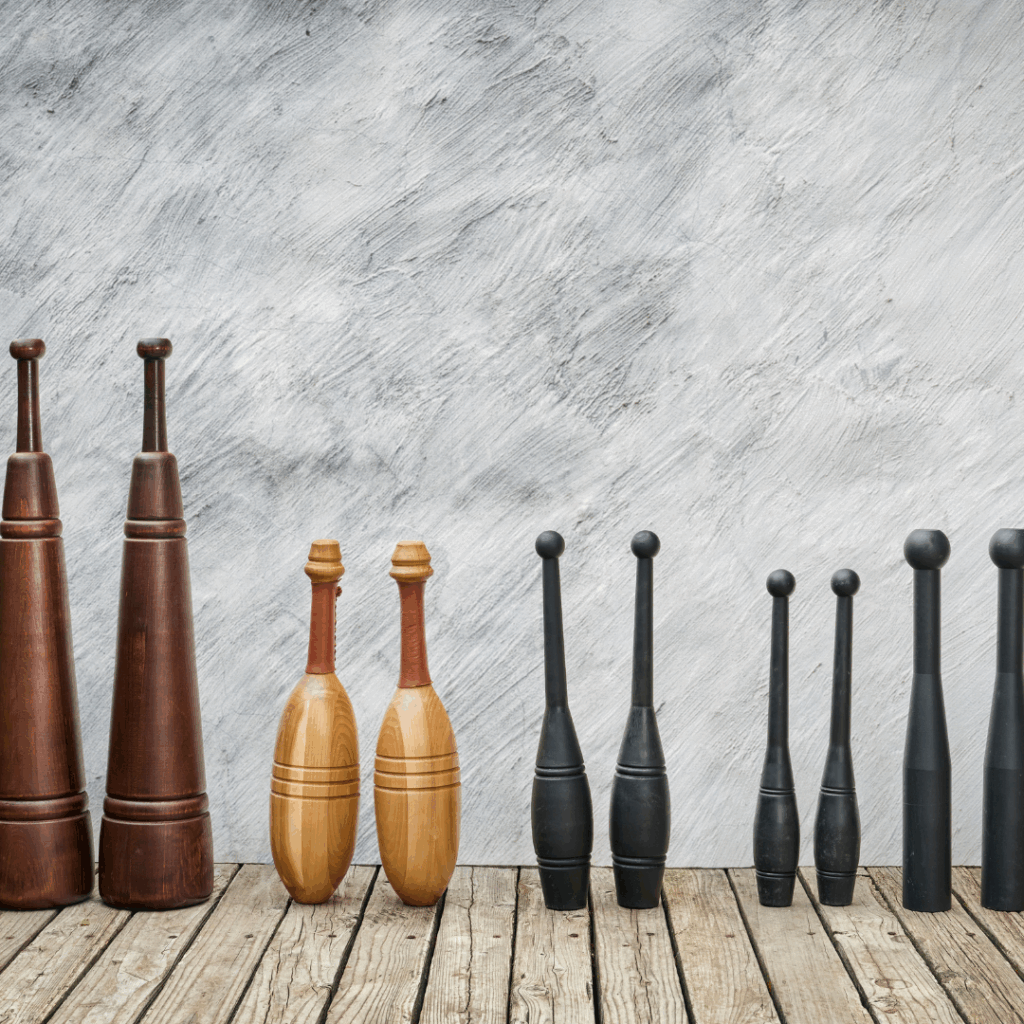
Light Indian clubs, the kind used for mobility, warm-ups & flowing circles, usually weigh 0.5 kg to 2 kg each (about 1 to 4.4 lb). Most are sold in pairs. Above that, you’re into heavy clubs, steel clubbells & the traditional mudgar or gada, which run from about 3 kg to 20 kg & more & are swung with one or two hands for strength. Club swinging has a long history in India & Persia, where heavy wooden clubs called mudgar, gada or meels have been used by wrestlers for centuries. The light wooden Indian clubs most of us buy today are the version that spread through Victorian Britain & the rest of the world as a fitness & health practice.
The number on the label only tells half the story. An Indian club carries most of its weight in the wide end, far from your hand. That makes a 500 g club feel much heavier on your wrist, elbow, shoulder & whole upper body than a 500 g dumbbell, because the load sits at the end of a long lever & keeps moving in a circular motion. Swing it faster & it feels heavier again. This is why the weight numbers for clubs look so small next to the weights you’d lift in a gym.
My starting weight rule: 500 g, up to about 1 kg
I start every beginner at 500 g per club, whoever they are. Some people can move up towards 1 kg within a few weeks, some stay at 500 g for months, & both are fine. Nobody starts heavier than 1 kg.
| Who you are | Start with (each club) | Move up to | Why |
|---|---|---|---|
| Desk worker, new to clubs | 500 g (about 1 lb) | 750 g, then about 1 kg | Light enough to keep the wrist loose while you learn the circles |
| Most women, or never trained before | 500 g | 750 g, then about 1 kg | You learn the patterns before your forearms tire |
| Most men, including gym-strong lifters | 500 g | About 1 kg once the patterns are smooth | Strength doesn’t speed up the skill; heavy clubs too early are the most common mistake |
| Over 60, or bone density concerns | 500 g | 750 g, only if it stays easy | Joints & balance come first; light clubs still give the full benefit |
| Back after a shoulder injury (cleared by your doctor or physio) | 500 g | 750 g-1 kg, slowly | Small, pain-free circles; the club should never pull you out of control |
| Athlete: martial arts, climbing or throwing sports | 500 g | About 1 kg | Grip & rotation transfer well once the patterns are clean |
Recommended Indian clubs weight by goal
| Your goal | Start | Later | Notes |
|---|---|---|---|
| Shoulder mobility & warm-ups | 500 g pair | 500 g-1 kg pair | Most people’s main reason; light is right, & you may never need more |
| Coordination & flow (both hands together) | 500 g pair | Up to about 1 kg | Heavier clubs make the timing harder to learn |
| Grip strength & forearms | 500 g pair | About 1 kg, then a little more | Progress slowly; the forearm tires before you notice |
| Strength & rotational power | 500 g pair to learn the patterns | A heavier single club or clubbell, much later | Not a starting point; earn it with months of smooth light work |
I’m keeping Indian club exercises & movements out of this guide, because the right weight is the question here. If you want the basic positions & first moves, my 4 things beginners must know about Indian clubs training covers grip, stance & the first patterns.
Start light: why lighter clubs beat heavy clubs for beginners
Almost everyone who walks into my class thinks they need a heavier club than they do. Many YouTube videos & Instagram clips show experienced swingers with heavy clubs, & that’s not where you start. Gym-goers especially pick up a pair of clubs weighing 500 g, laugh, & reach for something heavier. Five minutes later their circles have turned into ovals, their elbows are bending & their shoulders are up by their ears.
Here’s what’s going on. In a club swing, the club moves in a circle around your wrist, elbow or shoulder, & your job is to guide it with a loose hand. A club that’s too heavy makes you grip hard. A hard grip stiffens the wrist. A stiff wrist pushes the work into your elbow & shoulder, which is exactly where most desk workers are already tight. A light club lets the joints move through their full range while your muscles learn to control the momentum. That control, built in your nervous system one smooth circle at a time, is the whole point of Indian club training.
Lighter clubs also let you practise longer. The skill comes from many smooth repetitions, so a weight you can swing for a 5-10 minute workout teaches you far more than one you can only manage for 30 seconds. Light clubs are also the ones you’ll reach for to loosen up after a tough workout the day before.
Signs your Indian clubs are too heavy (or too light)
Too heavy if:
- Your knuckles go white or your forearms burn within a minute.
- Your shoulders creep up towards your ears.
- Your circles become wobbly ovals, or the club drifts away from your body.
- Your elbow has to bend to finish a circle that should be smooth.
- You hold your breath to get through a set.
- Your elbow, wrist or shoulder aches the next day.
Too light if:
- You can swing smooth circles for 10 minutes with no effort at all, & that’s been true for weeks.
- You no longer feel where the end of the club is during a swing.
Too light is rarely the problem. Your 500 g pair still has a job later on, as your warm-up clubs before a heavier session.
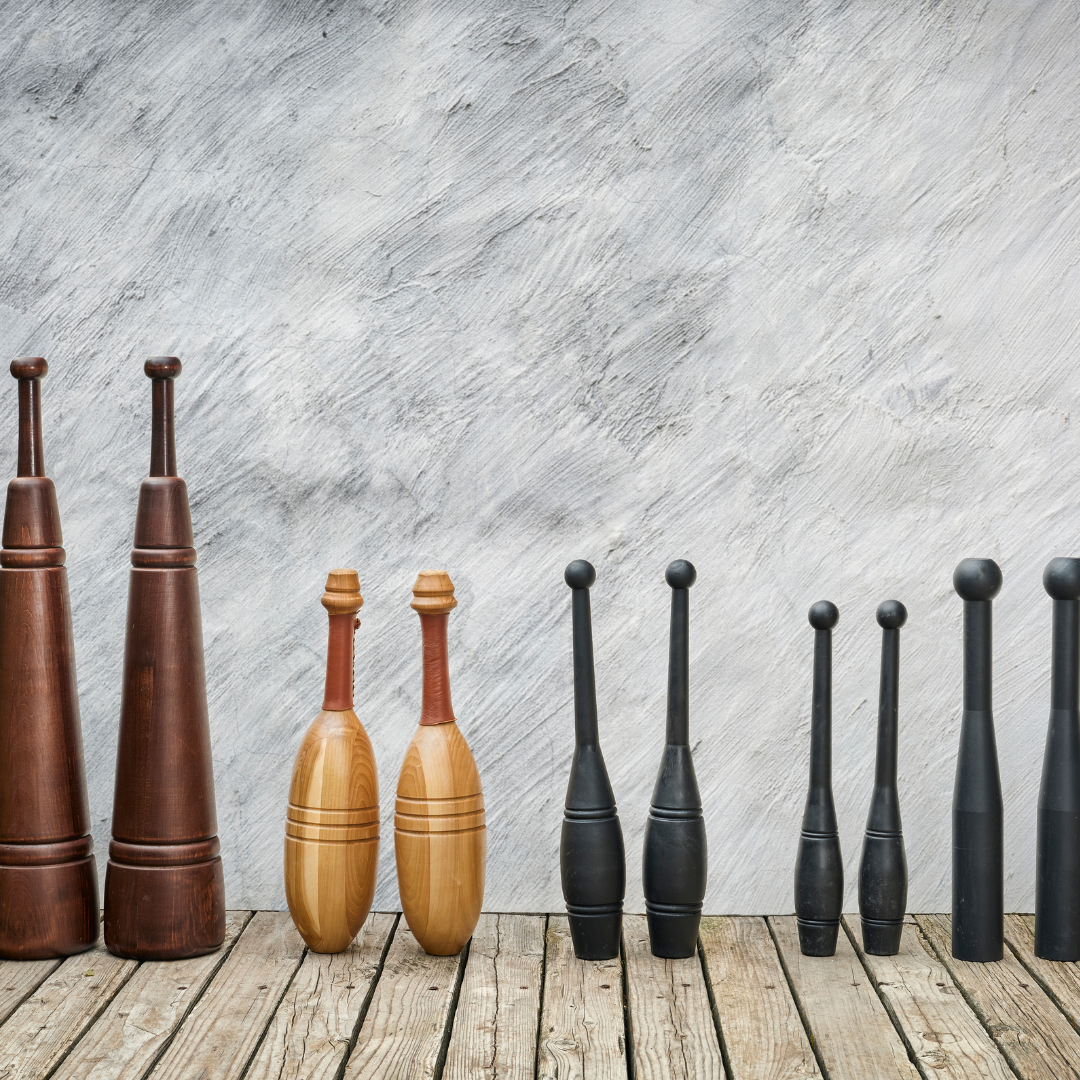
Same weight, different feel: length, shape & handle
Two clubs with the same weight can feel very different. When you compare Indian clubs size & shape, check four things.
- Length. Most light clubs are 40-55 cm (16-22 inches). Longer clubs put the weight further from your hand, so they feel heavier. For a 500 g first pair, around 40-45 cm (16-18 inches) is plenty.
- Where the weight sits. Good clubs have a slim handle & most of the weight in the body near the end. That’s what creates the swing. A club shaped like a straight stick won’t give you the same feel.
- Handle & knob. The handle should fit your hand without squeezing, with a knob at the end that stops the club slipping out on a sweaty Singapore evening.
- Material. Wood (beech, acacia, rubberwood) is the classic choice: warm in the hand, quiet, & easy to control. Plastic clubs are cheaper & tougher if you drop them, & plenty of good 1 lb & 2 lb pairs are plastic. A steel club or clubbell is compact & heavy, & built for strength work rather than first lessons.
Pounds or kilos? A quick conversion
Many listings, especially on Amazon, are in pounds. Here’s how the common sizes match up.
| Listed as | Per club in kg | Who it suits |
|---|---|---|
| 1 lb | about 0.45 kg | Every beginner: this is the 500 g pair I recommend |
| 1.5 lb / 750 g | about 0.7 kg | Your next step once 500 g is easy |
| 2 lb (two pounds) | about 0.9 kg | The top of the beginner range, about 1 kg |
| 3 lb | about 1.4 kg | Not a starting weight; months later, if at all |
| 4-5 lb | about 1.8-2.3 kg | Experienced swingers; the top of the light range |
| 10 lb + | about 4.5 kg + | Heavy club & clubbell work, usually one at a time |
The listing trap: some sellers write “1 kg Indian clubs” when they mean a pair weighing 1 kg in total, which is 500 g each. Others mean 1 kg each. Read the description, & if it doesn’t say “per club”, ask the seller before you buy.
Your first pair: which Indian clubs to buy
If a friend asked me which Indian clubs to buy first, I’d tell them: a 500 g (1 lb) pair, about 40-45 cm long, with a slim handle, a knob at the end & the weight in the body of the club. Then, only when that’s easy, a pair of about 1 kg (2 lb). Before purchasing online, have the chart above open next to the listing. Prices change, so check today’s price on each link.
- My first pick: a 1 lb (about 500 g) pair. This is the one I’d buy for any beginner. Brands like Synergee & Ultimate Body Press sell 1 lb pairs. See 1 lb Indian club pairs on Amazon. If you prefer wood, look at wooden 1 lb Indian clubs on Amazon.
- Your next pair: a 2 lb (about 1 kg) pair. For when the 500 g circles feel easy & you want a little more grip & shoulder work. See 2 lb Indian club pairs on Amazon.
- Buying in Singapore & want it fast? Search Shopee & Lazada for “Indian clubs 0.5 kg” & check the weight is per club. Tribal Fitness Singapore makes handcrafted wooden pairs locally, from 750 g, with pickup in Singapore, if you’d rather hold a club before you buy.
Amazon.com ships many of these to Singapore, but check delivery to your address before you pay. To be clear, I’m suggesting these on their size & shape; I haven’t tested every brand on these pages, so use the checklist below on any listing.
My buying checklist
- Weight per club is 500 g (1 lb) for your first pair, & never more than about 1 kg.
- Length about 40-45 cm for a first pair.
- Slim handle with a knob at the end.
- Weight in the body, not spread evenly like a stick.
- Smooth finish with no splinters or rough seams.
- Sold as a matched pair.
- A seller who answers questions & accepts returns.
Do you need a pair of clubs or one club?
Start with a pair of light clubs, 500 g each. Most beginner patterns are done with one club in each hand, & using both sides keeps you balanced. Swinging two clubs together is also what trains coordination, & it’s a good first fitness habit for anyone who sits all day.
A single heavier club is something for much later, once the light movements & exercises are second nature & your fitness training has a solid base. It’s not part of starting out, so don’t buy one with your first pair.
Before you swing at home (HDB edition)
- Look up. Swing the club overhead in your living room & measure the clearance. Turn the ceiling fan off. Yes, people forget.
- Clear a circle about the length of your arm plus the club around you. Move the TV & the glass table.
- Protect the floor. A dropped club can chip tiles, so practise on a mat, & start low & slow.
- Sweaty hands slip. Wipe your hands, & stop when your grip tires.
- Short & often beats long & rare. 10 minutes of regular practice most days is a good start; you’ll feel the difference in a few weeks.
A friendly doctor tip: if you have shoulder, neck or elbow pain right now, a recent injury or surgery, osteoporosis, or a heart condition, check with your doctor or physio before you start, & tell them which weight you plan to use. If something hurts sharply while you swing, stop & get it looked at.
When to go up a size (or add speed instead)
Move up from 500 g only when all of these are true for 2-3 weeks in a row:
- Your circles stay round & close to your body.
- Your grip stays relaxed & your shoulders stay down.
- You can do 10 minutes of the patterns you know without your form breaking.
- Nothing aches the next day.
Before you buy heavier clubs, try the cheaper progression: add speed, add time, or learn harder patterns with the same pair. Faster club swinging makes the same club feel heavier. When that’s easy too, go up in small steps, about 250 g per club: 500 g to 750 g, then to about 1 kg. Keep your 500 g pair for warm-ups.
Indian club training with a coach
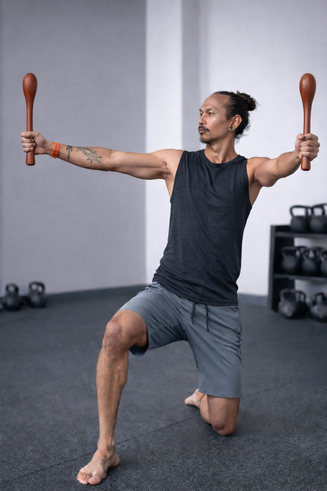
The weight matters, but technique matters more. A coach can spot a stiff wrist or a lifted shoulder in seconds, & can tell you on the spot whether your club is the right size. At MSMC we provide the clubs, so you can try the sizes before you buy any. Have a look at our Indian clubs class in Singapore, or read my Singapore beginners guide to Indian clubs & how Indian clubs train the nervous system & coordination. If you’re a trainer interested in teaching clubs, ITI runs an Indian club certification in Singapore.
FAQs
How heavy are Indian clubs?
Light Indian clubs usually weigh 0.5-2 kg (1-4.4 lb) each & are sold in pairs. Heavy clubs, clubbells & mudgars start at about 3 kg & go well past 10 kg.
What weight of Indian clubs should a beginner buy?
A 500 g (about 1 lb) pair. Every beginner should start between 500 g & about 1 kg per club, & 500 g is the best place to start.
Is 500 g too light for men?
No. Most men, even strong ones, learn faster on 500 g clubs, because the challenge is control, not load. Move up towards 1 kg once the circles are smooth.
Are 1 kg Indian clubs too heavy for beginners?
1 kg per club is the top of the beginner range, so it’s not where I’d start. Begin at 500 g & work up to 1 kg. Also check the listing: a “1 kg pair” may mean 500 g each.
Do I need one Indian club or a pair?
A pair to start, 500 g each. Most beginner patterns use both hands, & a pair keeps both sides balanced. A single heavier club is a much later add-on.
Can you build muscle with Indian clubs?
Light clubs build control, endurance, grip & shoulder health more than size. Heavier clubs & clubbells can build strength & some muscle, especially in the grip, forearms, shoulders & core, but they won’t replace lifting weights for muscle growth.
Where can I buy Indian clubs in Singapore?
Amazon.com sells 1 lb (500 g) & 2 lb (1 kg) pairs, many of which ship to Singapore (check delivery first); Shopee & Lazada have local sellers; & Tribal Fitness Singapore makes handcrafted wooden pairs from 750 g. Check the weight per club before you buy.
My verdict
Start light: 500 g per club for every beginner, & never above about 1 kg. Learn smooth circles first, add speed & time before weight, & keep the 500 g pair for warm-ups forever. If you want one pair to start with, get a 1 lb (500 g) pair.
As an Amazon Associate I earn from qualifying purchases. Translation: if you buy through my links, I get a small commission at no extra cost to you. It won’t buy me new clubs, but it might cover the next pair of 500 g ones I hand to a nervous beginner.