
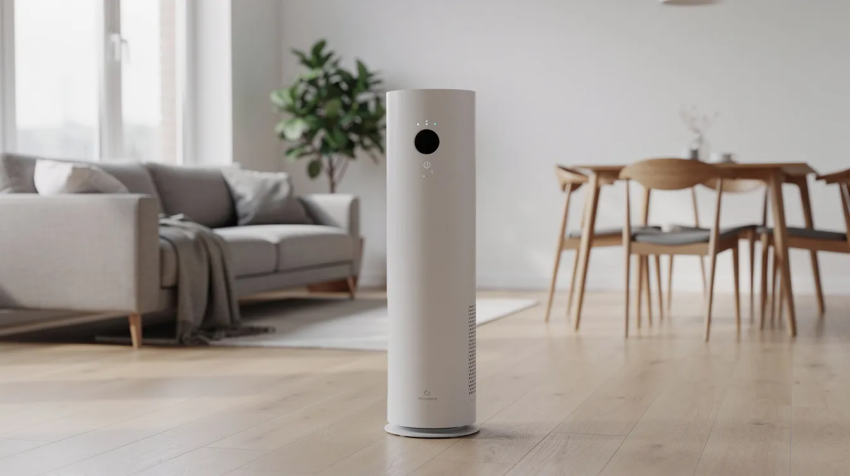
Are you on the fence about buying an air purifier due to the hazy conditions or thinking if it actually helps with clearing air quality, this article may change your mind.
If you live in Singapore, you already know the drill. Haze season rolls around, the PSI creeps up, windows stay shut, and suddenly the air indoors feels just as thick as outside. I’ve spent years studying how environmental exposure affects breathing, sleep and exercise recovery, and the reality is that fine particulate matter – PM2.5 specifically – penetrates deep into your lungs, triggers inflammation, and makes life miserable for anyone with asthma, allergies or even just a desire to sleep properly.
Here’s the thing: most people in HDB flats and condos keep windows closed and rely on aircon, but standard AC filters don’t do much against PM2.5 or the dust, pet dander and cooking odours that build up indoors. Add Singapore’s humidity (regularly above 80% RH), and you’ve got a recipe for mould, dust mites and genuinely poor air quality. An air purifier won’t fix everything, but the right one makes a measurable difference.
I’ve narrowed this down to three picks that cover the situations most Singapore households actually face: the Levoit Core 300S, the Xiaomi Smart Air Purifier 4 Pro, and a purifier-plus-dehumidifier combo for humid, mould-prone flats. Let me walk you through how I chose them and which one fits your space.

How We Chose the Best Air Purifiers for Singapore Homes
Every pick here is based on measurable performance – CADR, filtration grade, noise and suitability for local conditions – not just what’s trending on social media or what brand spends the most on marketing.
Clean Air Delivery Rate (CADR) and Room Size
CADR measures how many cubic metres of air a purifier cleans per hour. It’s the single most useful number on the box, far more honest than vague “covers up to X m²” claims, which often assume just one or two air changes per hour – not nearly enough during the hazy times.
A good rule of thumb: your matching CADR should be at least five times the room volume for effective air cleaning. For haze specifically, aim for a smoke CADR at least three times the room volume. A typical HDB bedroom (around 12–20 m²) needs roughly 200–300 m³/h. An open-plan living room in a 4-room or 5-room flat (25–40 m²) needs 350–500 m³/h or more. Room size directly influences the specifications you need, so measure before you shop. For context, the ION PUREAIR PRO 520 has a CADR of 520 m³/h and covers up to 100 m², while the Futur Living LUNA covers up to 935 square feet – both examples of units built for large spaces.
Filtration: HEPA, PM2.5 and Haze Particles
There’s one thing worth understanding here: not all “HEPA” labels mean the same thing. True HEPA filtration is the industry benchmark for air purifiers. A proper HEPA filter captures 99.97% of particles at 0.3 microns, which makes HEPA filtration effective against PM2.5 particles during haze. HEPA13 filters can also remove 99.97% of airborne germs, bacteria and allergens – essential for anyone fighting allergic rhinitis or asthma.
Watch out for “HEPA-type” or “HEPA-like” marketing. Those terms don’t carry the same certification and often underperform where it matters. HEPA filters are essential for removing allergens and harmful pollutants, but they cannot effectively remove gases and odours on their own – that’s where activated carbon filters come in. Activated carbon filters neutralise odours and VOCs from cooking, new furniture, paint and cleaning products, which are common irritants in Singapore flats. The Dyson HushJet, for instance, captures 99.97% of haze particles as small as PM0.39, while the Dyson Purifier Cool captures formaldehyde from furniture off-gassing – showing how different filtration layers tackle different problems.
Noise, Energy Use and Night-Time Use
Quiet operation is crucial for bedrooms. You want a noise level below 30 dB for sleep mode – anything above 40–50 dB starts to feel intrusive, especially in small rooms. The Levoit Core Mini, for example, operates at just 25 dB, barely a whisper. Air purifiers should also avoid ozone-generating features to ensure safety, so I’d lean toward mechanical HEPA filtration over ioniser-based systems.
Energy-wise, a 50 W unit running 24/7 costs roughly S$9–12 per month in Singapore. During haze, air purifiers should operate continuously to maintain air quality, so lower wattage on auto or sleep modes genuinely matters to your electricity bill.
Smart Features and Everyday Convenience
Smart features allow real-time air quality monitoring, which is more than a novelty – it means your purifier ramps up automatically when PSI spikes, even if you’re at the office. App control, scheduling and auto mode take the guesswork out. Xiaomi models have automatic filter replacement reminders in their app, which is a small detail that saves you from running a clogged filter for months without realising.
Value for Money, Not Just Price
The best air purifiers aren’t always the priciest. Consider filter replacement costs when choosing an air purifier: most air purifiers need filter replacements every 6–12 months, and those costs add up. Each Futur Living LUNA filter lasts approximately one year, while the Dyson HushJet filter lasts five years without replacement – a massive difference in long-term cost. Stock up on replacement filters during sale periods to save money over time.
Best 3 Air Purifiers in Singapore for Haze and PM2.5 (2026)
I’ve kept this to three distinct picks to avoid decision overload. Each one targets a real use case you’ll actually encounter in a Singapore home.
1. Levoit Core 300S – Best Budget Air Purifier for Bedrooms
The Levoit Core 300S is my go-to recommendation for anyone buying their first air purifier for a bedroom or small study. Priced around S$200–250 in Singapore, it punches well above its weight.
You can usually find the Core 300S on Shopee in that range – click here to check today’s price.

Why It Stands Out
Powered with a CADR of approximately 258 m³/h, this unit delivers several air changes per hour in a typical HDB. The H13-grade True HEPA filter handles PM2.5, pollen, dust and airborne particles from haze effectively. It’s compact enough to fit in tight layouts, quiet enough for light sleepers, and the smart control via app means you can fire it up remotely when the PSI jumps – genuinely useful during unpredictable haze days. The purification speed is impressive for a unit this size and price.
Best For
- HDB and condo bedrooms up to around 20 m².
- Students or young professionals wanting an affordable, effective first purifier.
- People with allergic rhinitis or mild asthma needing cleaner air at night.
- Parents putting a purifier in a baby or toddler’s room.
Key Strengths
- Approx. 258 m³/h particle CADR – enough for typical Singapore bedrooms at several air changes per hour.
- H13-grade True HEPA filtration for PM2.5, dust, pollen and pet dander.
- Activated carbon layer to help with cooking smells and light VOCs drifting in.
- Quiet sleep mode suitable for light sleepers (around 22 dB – almost background noise).
- Compact cylinder design that fits in tight HDB layouts.
- App control, voice integration and real-time air quality feedback.
Possible Limitations
- Not ideal as a single unit for large living rooms; CADR is tuned for small to medium rooms.
- No built-in dehumidification – won’t fix mould issues on its own in very damp flats.
- Ongoing filter cost needs to be factored in if used 24/7 through every haze season.
2. Xiaomi Smart Air Purifier 4 Pro – Best for Larger HDB and Condo Spaces
For most people needing to cover an open-plan living or dining area, the Xiaomi Smart Air Purifier 4 Pro is the upgrade that makes sense. Around S$369, it sits in the mid-range market but delivers flagship-level coverage. The Xiaomi Smart Air Purifier 4 covers up to 48 m², making it well-suited for combined living and kitchen zones in 3-room to 5-room flats.

Why It Stands Out
With a CADR of roughly 500 m³/h, this is the unit you want when windows are sealed and the haze is thick. The 360° air intake pulls in air from all sides, the HEPA filter handles fine particulate matter and airborne particles efficiently, and the large activated carbon bed – with 650,000 mg of carbon content – tackles cooking odours and formaldehyde. The OLED display shows PM2.5 readings in real time, and the auto mode ramps up purification when sensors detect a spike. Among Xiaomi units, this one does the job for the space where your family spends the most time. Air purifiers remove PM2.5 particles effectively during haze season, and this unit’s purification speed in large spaces is its strongest selling point.
Best For
- Families spending evenings in a shared living and dining area.
- Open-concept living rooms in newer BTO flats and condos.
- People wanting one main unit to handle haze in the heart of the home.
- Pet owners with dogs or cats shedding in communal areas.
Key Strengths
- High CADR (around 500 m³/h) suitable for 25–40 m² spaces at multiple air changes per hour.
- True HEPA-grade core filter for PM2.5 and finer haze particles.
- Large carbon section to tackle cooking odours that drift into the living area.
- OLED display with real-time PM2.5 readout so you can see air quality changes.
- Auto mode that ramps up when sensors detect a pollution spike.
- App connectivity for remote control and usage history tracking.
Possible Limitations
- Larger footprint – may be awkward in very tight living rooms or cluttered layouts.
- More expensive upfront and in filters than compact bedroom units.
- Still only purifies the room it’s in; bedrooms may need separate smaller units in heavy haze seasons.
- Peak noise at maximum fan speed reaches around 65 dB, so it’s not a bedroom unit.
3. Purifier + Dehumidifier Combo – Best for Humid, Mould-Prone Flats
Here’s what I would look at if your problem isn’t just particles but moisture. In Singapore, humidity regularly sits above 80%, and if you’re in a ground-floor HDB, a sea-facing condo, or you dry laundry indoors, you likely deal with mould on walls, musty wardrobes and that damp smell even with windows closed. A standalone air purifier won’t fix that – you need dehumidification alongside filtration.
The Philips 5000 Series DE5205/30 combines HEPA-grade filtration (CADR around 270 m³/h) with dehumidification capacity of up to 25 L per day, priced at approximately S$599. For larger spaces, models like the EuropAce remove up to 60 L of moisture daily. The LG PuriCare AeroFurniture eliminates up to 99.9% of bacteria indoors, while the SHARP KI-N50 purifies up to 400 square feet – showing there’s genuine competition in this space. But the combo approach saves floor space and addresses both threats simultaneously.
Why It Stands Out
Dust mites thrive at 75–90% relative humidity, and mould spores multiply above 80%. Keeping your indoors closer to 50–60% RH reduces both allergens significantly, on top of whatever the HEPA filter catches. This unit type can replace owning both a separate dehumidifier and a purifier in a bedroom or medium-sized room.
Best For
- Older HDB flats with known damp spots, peeling paint or recurring mould patches.
- Bedrooms where people dry clothes indoors or sleep with windows closed and aircon off.
- Allergy-prone individuals sensitive to both dust mite droppings and mould spores.
- Ground-floor or low-floor units and sea-facing condos with high ambient humidity.
Key Strengths
- Integrated HEPA13 or HEPA-grade filtration for fine particles and haze.
- Active dehumidification (up to 25 L/day, or up to 60 L/day in larger EuropAce models) to keep relative humidity closer to 50–60%.
- Helps reduce mould growth on walls, cupboards and mattresses over time.
- Smart Wi-Fi control and scheduling to run more aggressively during wet months.
- Often includes laundry-dry mode that doubles as air circulation and drying support.
Possible Limitations
- Bulkier and heavier than standalone purifiers – less convenient to move between rooms.
- Typically noisier in dehumidifier mode; may not be ideal right beside a light sleeper.
- Higher energy use (up to 355 W in hybrid mode), so better for targeted problem rooms rather than running all day in every space.
Quick Comparison of the Best Air Purifiers in Singapore (2026)
For busy readers, here’s the scan-and-decide version:
- Levoit Core 300S – Best budget HEPA air purifier for Singapore bedrooms and small HDB rooms; strong PM2.5 and haze performance for the price.
- Xiaomi Smart Air Purifier 4 Pro – Best for larger living rooms and open-plan areas where you need fast air turnover during haze periods.
- Purifier + dehumidifier combo – Best for damp, mould-prone rooms where humidity and air quality are both issues.
Worth noting: for a full 3-room or 4-room flat, you’ll likely want more than one unit. A bedroom purifier paired with a larger living room unit is often the most practical setup.
How to Choose the Right Air Purifier for Your Singapore Home
Choosing the right air purifier depends on room size and health needs. Here’s what I would look at.
Choose Based on Room Size and Layout
A small HDB bedroom (3 m × 4 m, ceiling 2.8 m) has a volume of about 34 m³. A Levoit-type unit with 258 m³/h CADR gives you over 7 air changes per hour – more than enough. A 5 m × 7 m living room at 98 m³ volume needs the Xiaomi’s 500 m³/h to hit 5 ACH. Match the unit to the room, not the whole flat.
Choose Based on Health Priorities: Haze, Allergies, Asthma
- People mainly worried about haze a few months a year: any of the three picks with True HEPA will do the job. Run it continuously when PSI spikes.
- Year-round allergy sufferers fighting dust, pollen and pet dander: prioritise consistent coverage in the bedroom where you spend 7–8 hours.
- Asthmatics or those with sensitive lungs: H13 HEPA is the minimum, and consider the combo if humidity triggers are part of the picture. The Dyson HushJet filter, which lasts five years, is another option worth research if budget allows.
Choose Based on Noise, Energy Use and Lifestyle
If you’re a light sleeper or have young kids, noise level matters more than CADR on paper. Sleep mode should sit at 25–30 dB. Smart scheduling and auto modes are a save for people who work long hours or travel – the purifier does the thinking.
When Humidity and Mould Are the Bigger Problem
The way I see it, if your walls are damp and your wardrobe smells musty, a purifier alone won’t fix it. You need dehumidification. Aim for 50–60% relative humidity indoors. If the mould is concentrated in one room, a combo unit there plus a Levoit in the bedroom is a practical, cost-effective island of clean air in your home.
Which Air Purifier Is Best for You?
The best air purifier in Singapore is the one that fits your specific room, budget and health profile. There’s no single machine that does everything for every flat.
- Choose the Levoit Core 300S if you mainly need a quiet, effective HEPA air purifier for a bedroom or small office on a sensible budget.
- Choose the Xiaomi Smart Air Purifier 4 Pro if your priority is keeping a larger living or dining space clean during haze and everyday cooking.
- Choose the purifier + dehumidifier combo if you’re fighting both poor air quality and high humidity or mould in the same space.
Don’t expect one unit at the corridor to purify the whole flat. Mix solutions based on where you actually spend time.
Final Thoughts on Buying the Best Air Purifier in Singapore
What actually matters is straightforward: CADR matched to your room size, proper HEPA filtration, manageable noise for sleep, and honest long-term running costs. Brand names and fancy design are secondary. These three picks give a solid starting point for most Singapore homes, whether you’re in a studio or a 5-room HDB. Leave a comment below & let me know what you decided to get!
