The breathing exercises to stop snoring that I teach come down to one goal: make nose breathing your default, by day and by night, and keep the tongue and throat muscles toned so the airway stays open. Most snoring is noise from soft tissue vibrating as air squeezes through a narrow airway, and mouth breathing makes that airway narrower. Below are the five exercises I use, how to do each one with easier and harder versions, how to use mouth tape safely, the habits that matter, and a simple 4-week plan. First, though, a 30-second check that tells you whether exercises are the right place to start at all.
By Jab. I created BreathEra and I’m an Advanced Oxygen Advantage instructor: I teach these exercises in my classes & to coaches. Sports medicine trainer & athlete for 20+ years, founder of MSMC in Singapore & ITI. Last updated 26 November 2026.
Quick pick for the night
MyoTape for Adults: the mouth tape I’d hand a first-timer. It sits around the lips rather than over them, so it nudges you to keep your mouth closed while still letting you open it if you need to. Use the exercises below by day; use the tape at night.
Use my code JABSMT for 10% off at Oxygen Advantage.
First, check it’s snoring and not sleep apnoea
Snoring on its own is common and mostly a nuisance, to you and to whoever shares your bed. Obstructive sleep apnoea (OSA, or “sleep apnea” in US spelling) is different: the airway closes again and again during sleep, breathing stops for seconds at a time, and it’s a real health issue, one of the sleep disorders that needs a doctor. Breathing exercises are not a treatment for it on their own. Ask your partner, or record yourself overnight with your phone, and see a doctor or a sleep medicine clinic first if any of these symptoms fit:
- Loud snoring with gasping, choking or snorting.
- Pauses in your breathing that your partner has seen.
- You’re sleepy in the day even after enough sleep, or you nod off when driving.
- Morning headaches, a dry mouth or sore throat most mornings.
- High blood pressure, or snoring that has got worse as your weight went up.
The American Academy of Sleep Medicine and the NHS both give the same advice: these signs need a proper sleep test. Moderate or severe sleep apnoea is usually treated with continuous positive airway pressure (CPAP) or an oral appliance, and that’s the right call. If that’s you, you can still do the exercises below alongside your treatment, but talk to your doctor before you try mouth tape.
Why mouth breathing makes snoring worse
Your nose is built for breathing at night: the nasal passages filter, warm and moisten the air and add a little healthy airflow resistance that slows your breathing down. When your mouth falls open, your jaw drops back, your tongue drops with it, and the upper airway behind it gets narrower and floppier. A small but neat study in healthy adults measured this during sleep: upper airway resistance was much higher when people breathed through the mouth than through the nose, and breathing pauses were far more frequent. That’s the mechanism I’m working on with clients. Train the nose to be the easy route, then keep the mouth closed at night, and the soft palate and throat have less reason to rattle.
Mouth breathing at night also dries you out. A dry mouth on waking, bad breath and, over time, poorer oral health are common complaints, so it’s worth mentioning to your dentist if you’re worried about your dental health.
The other half is muscle tone. The tongue and soft palate are muscle, and like any muscle they respond to training. That’s where the tongue and throat exercises come in.

The 5 breathing exercises to stop snoring I teach
Do these sitting upright, relaxed, at least an hour after a big meal. None of them should feel strained. If you get dizzy, anxious or breathless, stop and breathe normally.
1. Nose-only reset (daytime nasal breathing)
- Close your lips gently and rest your teeth slightly apart.
- Rest the whole tongue on the roof of your mouth, tip just behind the top front teeth.
- Breathe in and out through your nose only, quietly, into your lower ribs and belly.
- Do it for 5 minutes, three times a day: on waking, mid-afternoon and in the evening.
Easier: 2 minutes at a time while sitting at your desk. Harder: keep it going on a 20-minute walk, slowing down whenever you feel the urge to open your mouth. The aim is simple: your nose becomes the route your body chooses without thinking.
2. Breathe light (slow, quiet breathing)
- Sit tall, one hand on your chest, one on your belly, breathing through your nose.
- Make each breath a little smaller and softer than you want it to be, so your hands barely move.
- You should feel a light, comfortable hunger for air, as if you could take a slightly bigger breath. Hold that feeling, never a struggle.
- 4 minutes, twice a day. If the hunger becomes uncomfortable, take one normal breath and carry on.
Easier: just slow the out-breath, about 4 counts in, 6 counts out. Harder: breathe light while walking. This is the core of how I teach calmer breathing, and it’s why people often say they feel sleepy afterwards. That relaxed state is a well-documented effect of slow breathing.
3. Gentle breath hold to clear a stuffy nose
- Take a small, quiet breath in and out through your nose.
- Pinch your nose and hold the breath, nodding your head gently or walking a few steps.
- Let go when you feel a moderate urge to breathe (not a maximum), and breathe in through your nose, calmly.
- Rest for 30-60 seconds of normal nose breathing. Repeat 5 times.
Many people find this opens up nasal congestion for a while, which is useful before bed. Keep it gentle. Skip breath holds if you’re pregnant, have high blood pressure, heart problems, epilepsy, panic attacks or any other serious medical condition, unless your doctor says otherwise. If one side of your nose is always blocked, see a doctor: a deviated septum or nasal polyps won’t change with exercise.
4. Tongue & throat exercises (soft palate training)
These are the exercises with the best snoring research behind them. In a randomised trial published in Chest (2015), 39 adults who snored did either daily oropharyngeal (mouth and throat) exercises or a control routine for three months. Objectively measured snoring fell in the exercise group and didn’t change in the control group. A 2015 meta-analysis of this kind of myofunctional therapy also found snoring improved in adults. The studies were small, so think “may help”, not a guarantee. My version, done once or twice a day:
- Tongue slide: put the tip of your tongue on the roof of your mouth just behind your front teeth and slide it backwards along the palate. 20 times.
- Tongue suction: suck your whole tongue up flat against the roof of your mouth and hold for 2 seconds. 20 times.
- Tongue press down: keep the tip against your lower front teeth and push the back of your tongue down. 20 times.
- Soft palate lift: say “ah” in short bursts, feeling the back of the roof of your mouth (the soft palate) lift each time. 20 times, then one long “ah” for 5 seconds.
- Cheek press: put a clean finger inside one cheek and press the cheek outwards against it. 10 times each side.
- Mouth puffing: seal your lips, puff air into both cheeks and hold for 5 seconds without letting air escape through your nose or lips. 10 times.
Easier: 10 reps of each. Harder: two full rounds a day. Can you do myofunctional therapy yourself? These basics, yes. If you have jaw pain, a tongue-tie or a child who mouth-breathes, see a dentist or a myofunctional therapist.
5. Bedtime wind-down on your side
Lights off, lie on your side, lips together, tongue up. Breathe through your nose, about 4 counts in and 6 counts out, for 5 minutes. It links the daytime practice to the position you sleep in, and a calm nose-breathing pattern is a good place to fall asleep from. Easier: 2 minutes. Harder: add the light, smaller breaths from exercise 2.

Mouth taping: does mouth taping work for snoring?
Mouth taping means using a small strip of tape at night to keep your lips together, so you breathe through your nose. Does mouth taping work? The honest answer: for some people, and the research is thin. A 2022 study of 20 mouth breathers with mild sleep apnoea found that one week of mouth tape roughly halved their snoring index. But a 2025 systematic review in PLOS ONE looked at 10 studies (213 people) and found mixed results: two showed improvements, others showed no difference, and the authors warned of potentially serious harm when people with a blocked nose tape their mouths without checking. There are so few studies that there isn’t enough scientific evidence to call it a treatment.
That’s exactly why I teach the exercises first. If you can’t breathe comfortably through your nose for 20 minutes while awake, tape at night is the wrong tool.
Who should avoid mouth taping
- Anyone who has trouble breathing through the nose, or has nasal obstruction, a cold or blocked sinuses.
- Suspected or diagnosed sleep apnoea, unless your sleep doctor agrees.
- After alcohol, sleeping pills or sedatives.
- Children, unless a clinician advises it.
- Anyone with nausea, reflux that brings food up, or a history of skin irritation or an allergic reaction to adhesive.
How to start mouth taping safely
- Practise exercise 1 until 20 minutes of nose breathing feels easy.
- Wear the tape for 20 minutes while awake in the evening: reading, watching TV.
- Then try it for a nap or the first few hours of the night, and build up from there.
- Use breathable tape made for the face, with a gentle, medical grade or hypoallergenic adhesive, never household or duct tape. Shave or trim a heavy moustache, and peel it off slowly in the morning.
The mouth tape & nasal strips I use
| Product | Best for | Key facts | |
|---|---|---|---|
| MyoTape for Adults | First-timers; anyone nervous about a full seal | Cotton strip with hypoallergenic adhesive, goes around the lips; sizes by mouth width | See MyoTape |
| Therapin Recovery+ Collagen Mouth Tape | Confident nose breathers; dry lips | Keeps the lips together; latex-free, infused with collagen & vitamin E; ships from Singapore | See Therapin |
| MyoTape Nasal Strips | A nose that feels narrow at night | Adhesive strips that gently lift the sides of the nose; drug-free | See strips |
I don’t list prices because they change; click through for today’s price and shipping to you.
What I recommend first
MyoTape for Adults (Oxygen Advantage)
- What it is: a soft cotton strip with a gentle, hypoallergenic adhesive, created by Patrick McKeown, the author of The Oxygen Advantage. You stretch it slightly and stick it around your upper and lower lips; it draws them together without covering the mouth.
- How to use it: measure your mouth width first: Oxygen Advantage sells large (most men) and medium sizes. Start with 20 minutes awake, then nights.
- Good to know: Oxygen Advantage says it’s not a cure for any medical condition. Use code JABSMT for 10% off.
What I use
Therapin Recovery+ Collagen Mouth Tape
- What it is: a mouth tape from Therapin, a Singapore brand, that keeps the lips together. It’s drug-free and latex-free and infused with collagen, vitamin E, B5, B7, aloe vera and CoQ10 for the skin around the mouth.
- Why I use it: honestly, their mouth tapes are amazing, and it’s the one I reach for myself.
- Good to know: it ships from Singapore, so check delivery to your country. Because it seals more fully, I’d only move to it once you’re comfortable with nose breathing at night.
What about nasal strips? These adhesive strips lift the sides of the nose and can help you breathe easier, and the NHS lists nasal dilators as an option for a blocked or narrow nose. I compare the brands in my nasal strips guide. If your nose is the bottleneck, try a strip before mouth tape, or use both.
Habits that matter as much as the exercises
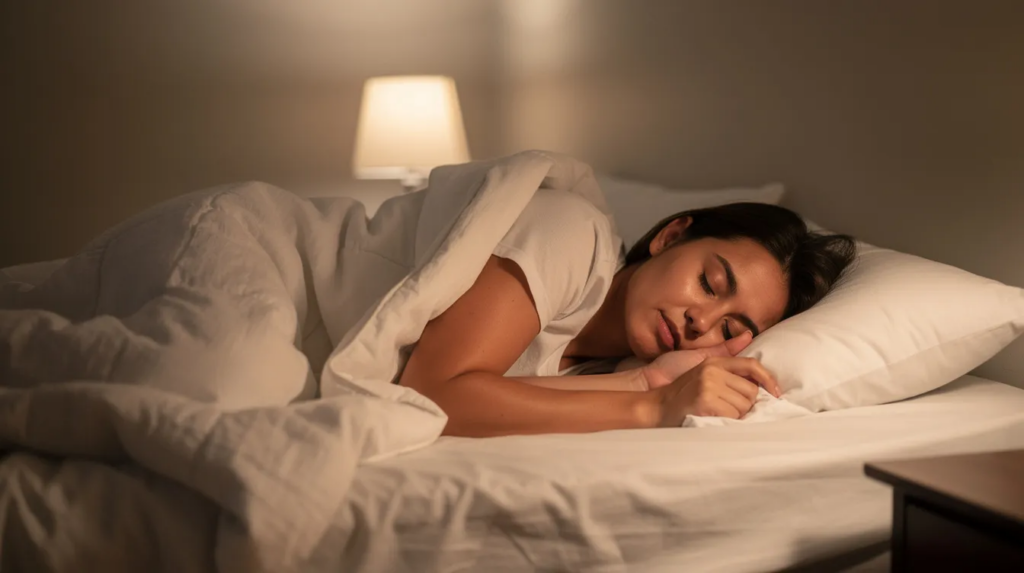
Breathing exercises work best alongside a few lifestyle changes. These are the ones I’d check first.
- Sleep on your side. On your back, gravity pulls the tongue and soft palate towards the throat. The old trick still works: sew a tennis ball into the back of a pyjama top, or use a firm pillow behind you.
- Cut the late drinks. Alcohol relaxes the throat muscles. A 2018 meta-analysis found higher alcohol intake was linked to a 25% higher risk of sleep apnoea. Alcohol also disturbs REM sleep. Stop 3-4 hours before bed, and avoid sleeping pills unless your doctor prescribed them.
- Lose weight if you carry extra. Weight around the neck narrows the airway. In a large US study, a 10% weight loss predicted a 26% drop in breathing pauses during sleep. Even a modest move towards a healthy weight counts.
- Treat nasal congestion & allergies. Talk to your doctor or pharmacist about a blocked nose that won’t clear. Saline rinses, a clean bedroom and fewer dust mites all help some people.
- Get enough sleep, on a regular schedule. Adults need 7 or more hours, according to the CDC. Being overtired can make snoring worse, so a regular bedtime and wake time help more than you’d think.
- Stop smoking, which irritates the lining of the nose and throat.
- Can eating before bed make snoring worse? A big late meal, especially with alcohol, can. Finish dinner 2-3 hours before bed.
Your 4-week plan to stop snoring
Here’s how I’d lay it out for a client. About 15-20 minutes a day, spread out. Talk to your partner and ask them to rate your snoring 0-10 each morning, or use a free snore-recording app, so you’re not guessing.
| Week | By day | At night |
|---|---|---|
| This week (1) | Nose-only reset 3 x 5 min; tongue & throat round once a day (10 reps) | Side sleeping; no alcohol 3-4 hours before bed; 2-min wind-down |
| Week 2 | Add breathe light 2 x 4 min; tongue & throat to 20 reps | Mouth tape for 20 min awake each evening (if your nose is clear) |
| Week 3 | Nose breathing on walks; breath hold before bed if stuffy | Tape for naps or the first half of the night; 5-min wind-down |
| Week 4 | Two tongue & throat rounds a day; keep the rest | Full nights with tape if comfortable; compare partner scores with week 1 |
After four weeks, look at the trend. If your snoring hasn’t changed, or your partner notices pauses or gasps, stop experimenting and book a sleep assessment. The trial above ran for three months, so keep going if things are moving in the right direction.
When breathing exercises aren’t enough
Some snoring has a structural cause: a deviated septum, big tonsils, a long soft palate or a small jaw. A doctor, often an ENT or a sleep medicine specialist, can look at your medical history and examine you. Options then include oral appliance therapy (a mouthguard-style device from a dentist that brings your jaw forward), positive airway pressure (CPAP) if you have sleep apnoea, or surgery in some cases. Exercises can sit alongside any of these treatment options, and nose breathing helps keep the airways open whichever route you take. They just shouldn’t replace a diagnosis.

If you’d like to learn this in person, I teach the BreathEra breathwork class at MSMC in Singapore. If you use a breathing trainer, read MSMC’s guide to using a breathing device safely. And if you’re a coach or therapist who wants to teach this to clients, look at the BreathEra instructor certification at ITI. For the bigger sleep picture, see my sleep stack.
FAQs
Can breathing exercises really stop snoring?
They may reduce it. Tongue and throat exercises reduced measured snoring in a small three-month trial, and nose breathing lowers airway resistance during sleep. They work best with side sleeping and less alcohol, and they don’t replace a sleep test if you might have sleep apnoea.
How long do breathing exercises take to work for snoring?
Give them at least four weeks of daily practice before you judge them. The best-known snoring trial ran for three months. Track it with partner scores or a recording app so you can see the trend.
Does mouth taping help with snoring?
It may help mouth breathers who can breathe easily through the nose, but the research is limited and mixed. A 2025 systematic review found few studies and warned of risks for people with a blocked nose, so check your nose first and start while awake.
Can you still snore if your mouth is taped?
Yes. Snoring can come from the soft palate and throat even with your mouth closed, especially on your back, after alcohol or with sleep apnoea. Tape only deals with mouth breathing, which is why the exercises and habits matter too.
How do I stop snoring immediately tonight?
Sleep on your side, skip alcohol and sleeping pills tonight, clear your nose with a gentle breath hold or a nasal strip, and do five minutes of slow nose breathing in bed. These are the quickest changes; the exercises take weeks.
What is snoring a red flag for?
Loud snoring with gasping, choking, pauses in breathing, daytime sleepiness, morning headaches or high blood pressure can be signs of obstructive sleep apnoea. See a doctor or sleep clinic for a sleep test before trying home remedies.
My verdict
Start with the check: if there are signs of sleep apnoea, see a doctor first. If it’s plain snoring, make your nose the default with the nose-only reset and breathe light by day, train your tongue and soft palate daily, sleep on your side and cut the late drinks. Once nose breathing feels easy, add mouth tape at night, starting with MyoTape. Give it four weeks, measure it, and keep going if it’s working: small daily practice is how most people improve snoring and get a better night’s rest.
Your turn
Do you snore, or does your partner? What have you tried, and did anything work? Tell me in the comments below. I read every comment and reply, and your answers help other readers too.
I earn a commission if you buy through some links on this page (Oxygen Advantage), at no extra cost to you.