Yes, a kinesiology taping course is worth it for most personal trainers, as long as you choose a hands-on one & you’ll actually use tape with clients every week. Two days of supervised kinesio taping teaches you more than months of web videos, because someone corrects your stretch, your angles & your skin prep while you work. It won’t turn you into a therapist, but it gives you one more honest, low-cost tool for comfort & confidence in training.
By Jab, founder of the Integrated Training Institute (ITI) & Movement & Sports Medicine Centre (MSMC) in Singapore. Last updated 21 November 2026.
Key facts: ITI’s Kinesiology Taping Clinic
- Length: 14 hours over 2 days
- Format: about 80% hands-on & 20% lecture
- Prerequisites: none, so trainers, coaches & fitness enthusiasts are all eligible
- Covers: contraindications, the ‘Recoil System’, live case studies, injuries, preventative, postural, edema & movement taping
- Included: unlimited rolls of tape for practice, an ebook & an e-certificate of completion
- Award: Proficiency in Kinesiology Taping (no CEUs are given for it yet)
- Course information: dates & pricing are on the course page

My short answer, as someone who teaches it
I’ve coached & taught for more than 20 years, and I teach kinesio taping to trainers & other practitioners through ITI, which I founded in 2010 to train fitness professionals & therapists. So take my view with that in mind: I’m not neutral about the subject, but I am honest about where tape fits.
Here’s how I see it. A kinesiology taping course is worth it when three things are true:
- You work with people who move: clients, athletes, weekend runners, older adults coming back to training.
- You’ll keep taping between sessions, on yourself, your colleagues & your clients (with their permission).
- You treat tape as an add-on to good coaching, not a replacement for it.
If any of those isn’t true yet, wait. A certificate you never use is just paper.
Kinesiology tape in plain words
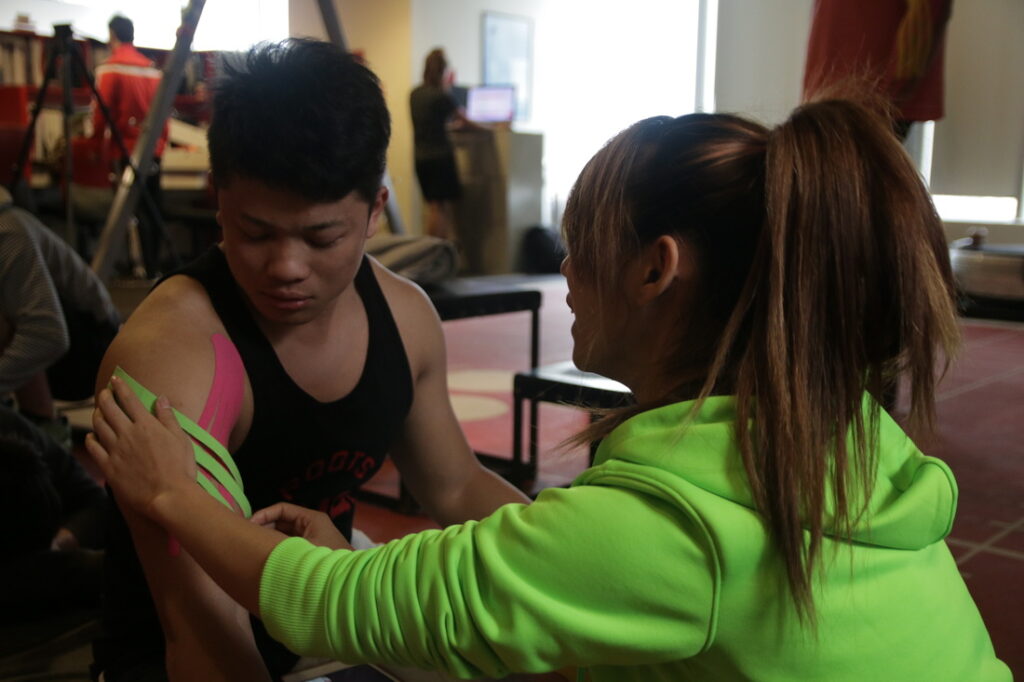
Kinesiology tape is an elastic tape that adheres closely to the skin. Unlike rigid sports strapping, it gives light support without significantly restricting normal movement, which is why it’s used widely in sports medicine & rehabilitation settings. Different techniques do different jobs: some support or facilitate a muscle, some calm down an overactive one, and some are cut to help with swelling (lymphatic or edema taping).
It works best as a complementary tool alongside rehab & training, and it’s often combined with other approaches. Common goals are managing pain & improving function. How well it works varies with the condition and the person: users report mixed but often positive short-term effects.
Taping courses vary too, from short workshops to multi-day certification programmes. Most mix theory & practical application, covering anatomy, application techniques & safety. Many are designed for healthcare clinicians & sports professionals, and many give continuing education credits (ours doesn’t yet).
What kinesio taping can & can’t do for your clients
I start every workshop with this, because it protects trainers & the people they work with. Kinesio taping uses a light, stretchy tape that sits on the skin over muscles & joints. Used well, it can help a client feel more supported, more aware of a joint & more comfortable moving. Many people like how it feels under load, and that matters for confidence.
What it can’t do: fix poor programming, replace strength work, or act as a therapy for an injury on its own. The research on taping for pain is mixed, and I tell trainers that on day one. There’s no single kinesio taping method that suits every body either. I’d rather you under-promise & let clients notice the benefits themselves. In my experience, the benefits clients mention most are comfort & confidence, not dramatic change.
Where I find it most useful in a gym:
- Posture cues: a strip that reminds the client where their shoulder blade or lower back should be during a lift.
- Comfort while training around niggles: light support over the muscles around the knee, elbow & shoulder so a client keeps moving instead of stopping altogether.
- Swelling: edema taping techniques are taught in the clinic, but anything with real swelling after an injury goes to a doctor or physiotherapist first.
- Prevention: preventative taping for athletes before a heavy block of training or a competition.
What a good kinesiology taping course should teach
Whatever you choose, check that it covers these. They’re the things I see self-taught trainers miss most often.
- Contraindications first. Broken or fragile skin, allergies, and conditions where taping isn’t appropriate. If a workshop skips this, skip it.
- Tension, not just shapes. Most mistakes come from stretching the tape too much. The ‘Recoil System’ we teach is about how much the tape is stretched & where it recoils.
- Assessment before application. You should learn to look at how someone moves, then tape, then re-check. Our clinic aims to teach you to assess, tape & correct movement patterning.
- Different tapes, one technique. Brands differ in stretch & adhesive. A good teacher shows you how the tapes differ and how to adjust, so you’re not locked to one product or one kinesio taping method.
- Live feedback. You need someone watching your hands. Ours is about 80% hands-on, with live case studies.
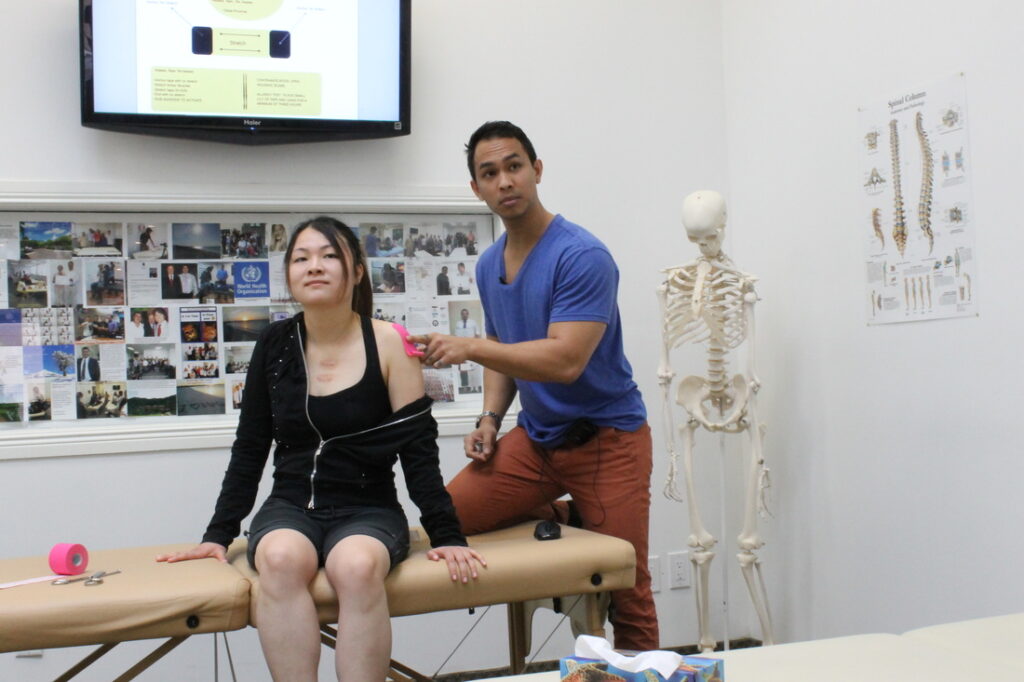
What ITI’s Kinesiology Taping Clinic covers
The Kinesiology Taping Clinic is designed as a short, practical workshop. Here’s what’s on the course page, in plain words:
- Practical application of the core techniques, with plenty of time on the tape.
- Contraindications for taping.
- The ‘Recoil System’, one technique you can use with all types of kinesiology & sports tape.
- Injuries & preventative injury taping.
- Postural taping & movement taping for training sessions, from the knee & elbow to the shoulder & back.
- Edema taping, for the swelling conversation above.
- Live case studies, so you tape real bodies, not diagrams.
Practical notes: wear comfortable, loose clothes. Many techniques need the abdomen, back & glutes exposed, so come in clothing suitable for skin contact. Unlimited rolls of tape are provided over the two days, you get an ebook to follow afterwards, and you receive an e-certificate.
Kinesio taping course or web videos? A quick comparison
Trainers ask me this a lot. Here’s my honest comparison of the main ways tape users learn.
| Option | Hands-on time | Feedback on your technique | Contraindications | Certificate | Best for |
|---|---|---|---|---|---|
| Free web videos | On yourself only | None | Often skipped | No | Curiosity, personal use |
| Online taping course | Limited | Little or delayed | Usually covered in theory | Sometimes | Theory before a live course |
| 2-day hands-on course (like ITI’s Taping Clinic) | 14 hours, about 80% practical | Live, while you tape | Covered in practice | E-certificate of completion | Trainers & coaches who’ll use it with clients |
| Longer pathway (e.g. ITI’s Sports Medicine Certificate, currently an invite-only intern intake) | Taping plus many other tools, with an internship | Ongoing, supervised | Covered | Certificate after a theory exam | Trainers building a sports medicine career |
Who I’d recommend it to (and who should wait)
The clinic is open to chiropractors, physiotherapists, manual therapists, osteopaths, physical therapists, personal trainers, coaches, athletic trainers & fitness enthusiasts. In my experience it’s most useful for:
- Personal trainers working with clients who have aches, old injuries or postural habits.
- Coaches of athletes who want preventative taping before training & competition.
- Group instructors who want a simple tool for common complaints like a sore knee or tight back.
- Therapists who want a consistent, simple system across different tape brands.
A note for new tape users: if you’re a brand-new trainer still learning to coach a squat & a hinge, wait. Get your coaching basics solid first. Tape on top of poor technique is still poor technique.
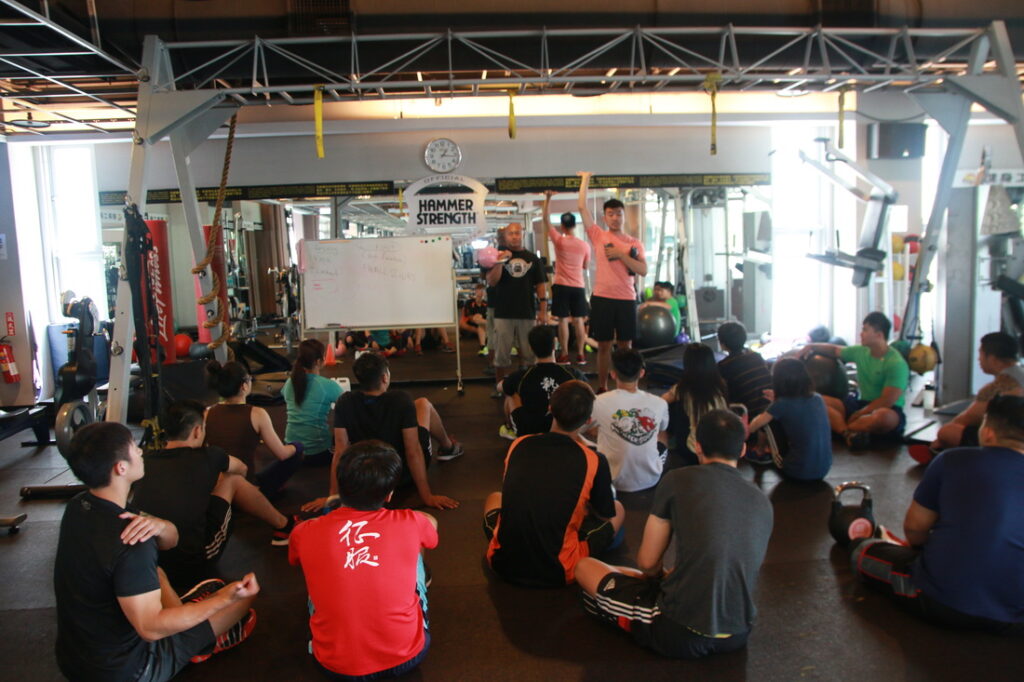
How I’d use taping in a personal training session
This is the order I’d follow with a client. It keeps taping honest and part of the training, not a gimmick.
- Assess first. Watch what bothers them: a squat, an overhead press, a lunge.
- Check for red flags. Sharp pain, numbness, a recent injury or unexplained swelling means see a doctor first, not tape.
- Prepare the skin. Proper skin preparation matters for safe application: clean & dry. In Singapore’s heat & humidity, sweat is the biggest reason tape lifts early, so tape before the client warms up.
- Apply with the right tension. Less is usually more. Anchor the ends without stretch.
- Re-test. If nothing changes, the tape isn’t the answer today. Move on to the training.
- Monitor & teach. Watch how the client responds over the session. Teach them how long to wear it, how to remove it gently, and to take it off if the skin itches or reddens.
At MSMC we test, we don’t guess, and that’s the same rule I use with tape. If you want to see how a sports medicine approach to training works with people in pain, MSMC has a guide on it: can a personal trainer help with pain?
Questions to ask before you book any taping course
If kinesio taping has caught your interest, ask these first. A good provider will answer them happily.
- How many hours are hands-on, and how many people are taping at once?
- Are contraindications taught & practised, not just mentioned?
- Will I tape different body areas: knee, elbow, shoulder, back?
- What tape do I practise with, and is it provided?
- What do I get on completion, and are CEUs given? (Not for ours yet, and we say so.)
- Can it count towards a bigger qualification later?
- Where do advanced concepts come in, after the basics?
On that last point: the Kinesiology Taping Clinic is one of the courses ITI lists that can be combined with others & converted towards the Sports Medicine Trainer certificate. Kinesio taping also appears inside each level of that certificate, from I-strips in Level 1 to Y-strips in Level 2 & fan taping in Level 3, which is where the more advanced concepts sit. If you’re curious about the bigger pathway, I explain it in what a sports medicine personal trainer does. Right now that certificate is an intern intake by invitation only, with no open sign-up, so if it interests you, register your interest on ITI’s Sports Medicine Certificate page.
So, is a kinesiology taping course worth it?
For a personal trainer who’ll use it every week, yes, the benefits are worth it. It’s two days, there are no prerequisites, and you leave with a skill you can use the next week, plus the judgement to know when not to use it. That last part is what separates a professional from someone who watched a few videos.
If you’d like to see the next dates & pricing, or ask whether it suits your work, enquire about this course on the ITI course page.
FAQs about kinesiology taping courses
Can you become a certified kinesio taping practitioner?
Yes. Many courses give a certificate. Some people search for a “certified kinesio taping practitioner” title, which belongs to a specific organisation’s programme. ITI’s Kinesiology Taping Clinic awards an e-certificate of completion for Proficiency in Kinesiology Taping.
Is there an online kinesiology taping course?
There are online taping courses, and they’re fine for theory. I still recommend a hands-on kinesio taping course, because tension & placement are hard to judge without someone checking your application.
When should you not use kinesiology tape?
Don’t tape over broken, irritated or fragile skin, over a known tape or adhesive allergy, or instead of getting a new injury, unexplained swelling or numbness checked. Contraindications are taught in the clinic.
How long does kinesiology tape take to work?
Some clients notice a difference in how a lift feels straight away; others don’t notice much. That’s why I re-test after taping and keep the tape only if it helps.
Is there one kinesio taping method for everything?
No. The ‘Recoil System’ gives you one way of thinking that works across different tapes, but the application changes with the person, the body area & the goal.
When do I learn advanced concepts in taping?
After the basics. Within ITI’s Sports Medicine Trainer certificate, taping progresses from I-strips in Level 1 to Y-strips in Level 2 & fan taping in Level 3.
Do I need a qualification to attend?
No. There are no prerequisites, so trainers, coaches, therapists & fitness enthusiasts are all eligible to attend.
What’s the refund policy?
Please read ITI’s course policies before you register: https://www.itigrad.com/course-policies.html